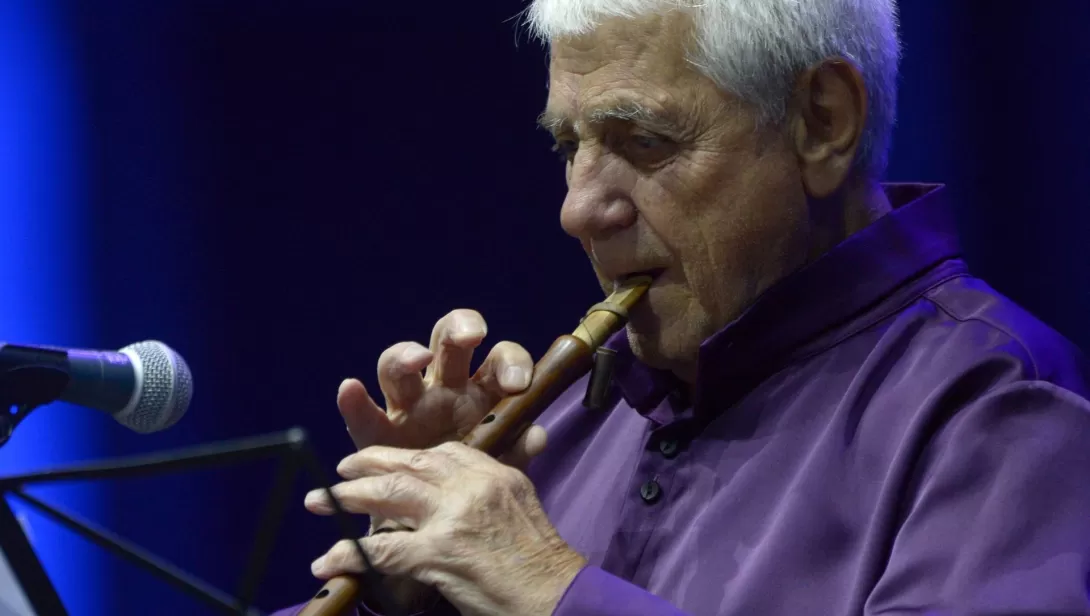
Djivan Gasparyan was an Armenian musician, composer and master of the duduk. He recorded the album Armenian Folk Melodies in 1983 and contributed to the music for Gladiator in 2000. He performed with musicians from a range of genres and taught at the Yerevan Conservatory, preparing duduk players for professional careers.
Solak and his first notes on the duduk
Djivan Aramaisovich Gasparyan was born on October 12, 1928, in the village of Solak, near Hrazdan. He began teaching himself the duduk at six, listening to older musicians and trying to reproduce what he heard. He also learned to play the zurna and shvi.
Gasparyan spent part of his childhood in an orphanage, where the other children were his audience. By 1946, he was performing in Moscow with an amateur ensemble at a showcase of artists from the Soviet republics.
The ensemble, the stage and teaching
In 1948, Gasparyan joined a national song and dance ensemble. That same year, he made his first professional appearance as a soloist with the Yerevan Philharmonic Orchestra. The duduk he had taught himself to play became his instrument onstage.
In 1956, he won first prize in a competition for duduk players. A year later, he traveled to the United States with the Beryozka ensemble on his first tour abroad.
From 1976, Gasparyan taught at the Komitas Yerevan State Conservatory, where he was a professor and trained professional duduk players. In 1978, he was named a People's Artist of the Armenian SSR.
A record and an international audience
Armenian Folk Melodies was Gasparyan's first solo album. He recorded it for the Melodiya label. In 1989, Brian Eno's label Opal Records reissued the record under the English title I Will Not Be Sad In This World.
A year before the reissue, in 1988, Gasparyan was invited to London. He gave five concerts instead of the two planned and was then invited to the United States. He also worked there from the late 1980s onward.
Gasparyan toured the world with a small ensemble playing Armenian folk music. He sang onstage, too. During one concert, he set down his duduk and sang a song he had written in a high voice.
The duduk in film music
In 1988, Gasparyan worked with Peter Gabriel on the music for Martin Scorsese's film The Last Temptation of Christ, playing the duduk part. The two later performed together in concert as well.
Hans Zimmer and Lisa Gerrard worked on the soundtrack for Ridley Scott's Gladiator. Zimmer invited Gasparyan into the studio, played the music and asked him to perform a part. Gasparyan recalled: “I listened to it twice and said, ‘We can record now.’”
In 2003, Gasparyan wrote the music for Alexander Gutman's film Frescoes, which depicted life in Armenia after the earthquake and the collapse of the Soviet Union. The film's music was later released as a separate album of the same name.
In 2004, his duduk was heard in the music for Mel Gibson's The Passion of the Christ. A year later, Gasparyan performed in Tromsø, Norway, with guitarist Brian May and Peter Gabriel, who played keyboards. A video recording survives of their performance of Gabriel's composition The Feeling Begins.
Recognition and the next generation
In 2002, Gasparyan received a WOMEX award for his contributions to music. He continued to perform and teach. Among his students was his grandson and namesake, Djivan Gasparyan Jr., who was born in Yerevan on October 23, 1982.
The younger Gasparyan studied the duduk with his grandfather while also taking lessons in piano, singing and music literacy. When the elder Gasparyan felt he was ready to perform, he expanded his trio into a quartet. In that lineup, the younger musician appeared at the Hollywood Bowl in Los Angeles, the Kremlin in Moscow and concert venues in other countries.
In November 2008, the grandson took part in concerts in Yerevan marking his grandfather's 80th birthday. In 2009, they performed at the WOMAD festival in Abu Dhabi and played melodies from Gladiator as a duo.
In May 2010, the elder Gasparyan joined Eva Rivas, who represented Armenia at Eurovision. He played the duduk in the semifinal on May 27 and the final on May 29. On April 29, 2011, he took part in the concert Three Legends in the Kremlin, performing with the Presidential Orchestra of Russia and the men's choir of Moscow's Sretensky Monastery.
Djivan Gasparyan died on July 6, 2021, in his 93rd year. His grandson and student, Djivan Gasparyan Jr., continues to perform. Concert listings under that name for 2026 refer to him.