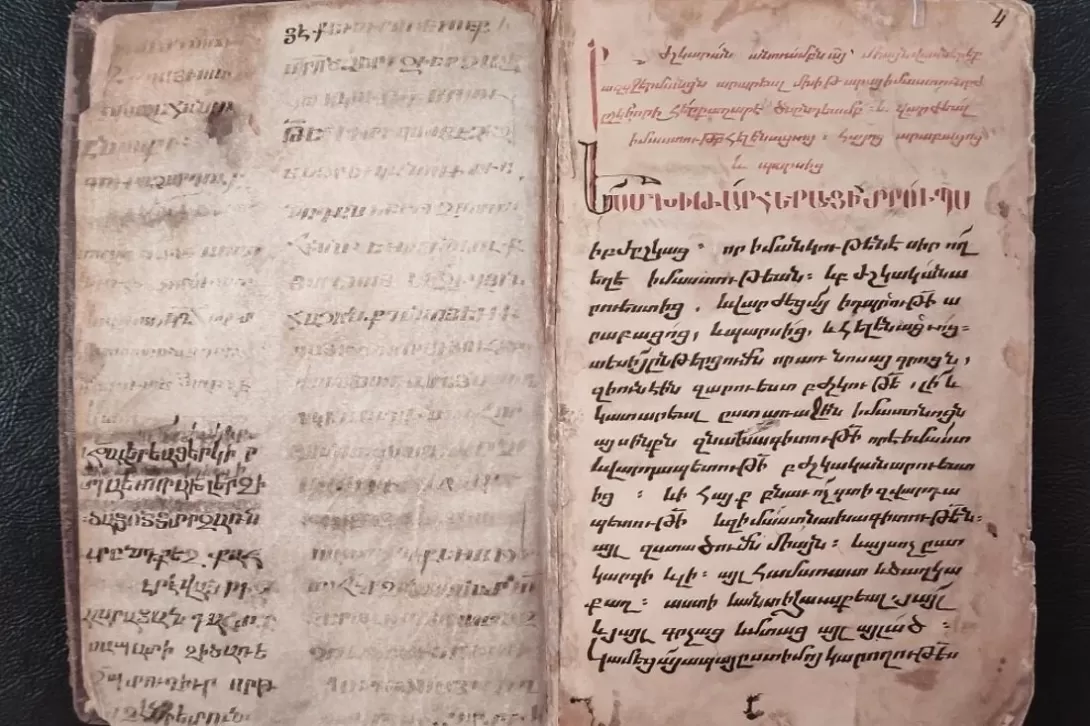
Mkhitar Gosh’s Code of Laws presented in Yerevan with commentary by legal scholars
A new Russian-language edition of Mkhitar Gosh’s Code of Laws was presented at the House of Moscow Cultural and Business Centre in Yerevan, Yerkramas reports. Moscow-based publisher Dreambook released the book, supplementing the medieval Armenian legal text with detailed commentary by contemporary legal scholars.
The book is based on A. A. Papovyan’s translation, published in 1954 by the Armenian SSR Academy of Sciences publishing house. The new edition appeared in 2026, more than 70 years later. Scholarly commentary has been added to the earlier text, making this more than a straightforward reprint.
The volume was compiled and academically edited by Ruben Markaryan, who holds a Candidate of Legal Sciences degree and is vice president of the Guild of Russian Lawyers. He heads the Centre for Free Legal Aid at the Russian and New Nakhichevan Diocese of the Armenian Apostolic Church. Markaryan is also a member of the Union of Writers of Russia and heads the online media outlet Zakoniya.
Mkhitar Gosh, a medieval Armenian thinker, theologian, writer and public figure, wrote the Code of Laws in 1184. In it, he brought together secular and ecclesiastical rules, regulated property and family relations, and defined crimes and punishments.
At the presentation, Markaryan drew attention to when the Code of Laws was written. It appeared 31 years before England’s Magna Carta of 1215. The academic editor believes Armenian heritage deserves greater attention from the legal community. Gosh’s work was added to UNESCO’s Memory of the World International Register on April 10, 2025.
The proposal to republish the book came from the international public organization Union of Criminalists and Criminologists. Markaryan said the idea emerged after an international conference on medieval law that brought together research and practice. O. E. Kutafin University, the Union of Criminalists and Criminologists, and the Academy of Justice of the Republic of Armenia helped organize the forum.
The presentation was supported by Moscow’s Department for External Economic and International Relations and the House of Moscow in Yerevan. The centre’s director, Ayk Melikyan, stressed that projects like this strengthen cultural ties. He highlighted Markaryan’s work in legal education and in introducing Russian-speaking readers to Armenian culture.
Markaryan also has educational plans for the new edition. He expressed hope that the book would help Russian-speaking students in Armenia and Russia, including future lawyers, study Armenian legal and philosophical thought.