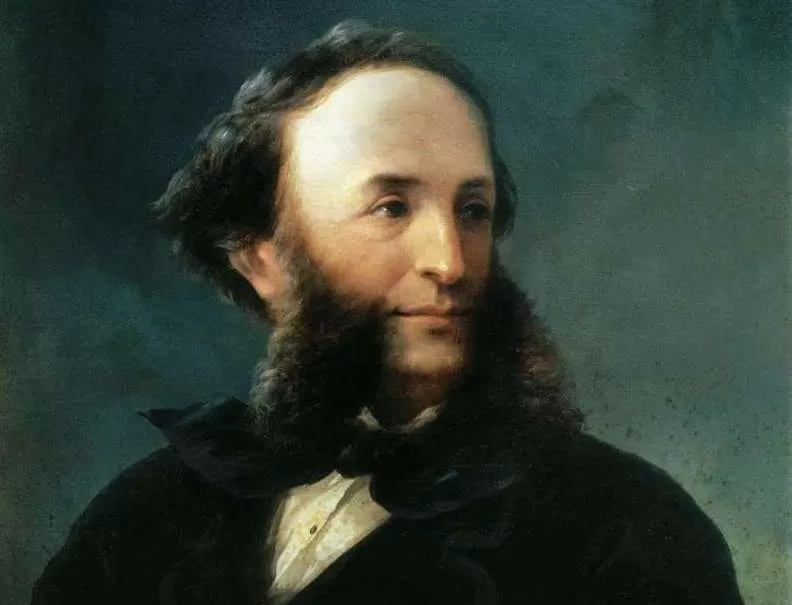
How Ivan Aivazovsky Became a Painter of the Sea
Ivan Konstantinovich Aivazovsky (1817–1900) was a marine painter of Armenian descent whose works include The Ninth Wave (1850) and The Black Sea (1881). Over his lifetime, he produced around six thousand paintings, which were exhibited in St. Petersburg, Moscow, European capitals and other cities.
An Armenian Family and a Childhood in Feodosia
Aivazovsky was born on 17 (29) July 1817 in Feodosia to an Armenian family: the merchant Gevork and his wife Ripsime Aivazyan. His father was also known as Konstantin. The boy was given the name Ovanes at his baptism.
According to Wikipedia, Ovanes is the Armenian form of John, while the artist’s father wrote the surname Gaivazovsky in the Polish manner. The painter became widely known as Ivan Konstantinovich Aivazovsky.
Wikipedia also includes an extract from the parish register of the Armenian Church of Surb Sarkis in Feodosia, recording the birth and baptism of “Ovannes, son of Gevork Aivazyan.”
His first professional drawing lessons came from the Feodosia architect Ya. Kh. Kokh. The young artist received support from Alexander Kaznacheyev, who helped him continue his education in Simferopol. After attending the local district school and the Simferopol gymnasium, Aivazovsky left for St. Petersburg in 1833 on the recommendation of his drawing teacher, I. Gross.
Studies in St. Petersburg and His First Awards
In 1833, Aivazovsky entered the Imperial Academy of Arts. He studied under the landscape painter Maxim Vorobyov, the French marine painter Philippe Tanner and the battle painter Alexander Sauerweid. Even in his student work, he turned to the sea, depicting the changing skies above the water.
In 1835, his landscapes View of the Seashore near St. Petersburg and Study of Air over the Sea earned a silver medal. Two years later, Aivazovsky received a large gold medal for Calm. In 1838, the Academy brought his studies to an early close, two years ahead of schedule, and sent him to Crimea to work independently.
In Crimea, the artist painted from life and also worked on battle scenes. Emperor Nicholas I purchased his paintings The Landing at the Subashi House and View of Sevastopol in 1840.
European Travels and Professional Recognition
After working in Crimea, Aivazovsky travelled to Europe to hone his skills at the Academy of Arts’ expense. Between 1840 and 1844, he visited Italy, Germany, France, England and Spain. In Rome, he painted Chaos, which was purchased by Pope Gregory XVI.
At the Paris exhibition in 1843, his paintings Boat of Circassian Pirates, Calm on the Mediterranean Sea and The Island of Capri were awarded a gold medal. In 1844, Aivazovsky became a painter to Russia’s Main Naval Staff. Three years later, he was awarded the title of professor at the St. Petersburg Academy of Arts.
In 1857, the artist produced a series of four landscapes, The Riches of Russia, for which he received the French Legion of Honour. He continued to exhibit in Europe, including in Florence, where an exhibition of his paintings took place in early 1873.
The Sea and His Major Paintings
In The Ninth Wave, Aivazovsky depicted sailors who had survived a shipwreck. Clinging to the wreckage of a mast, they try to escape an enormous wave. The artist also explored the history of naval battles, painting The Battle of Navarino and The Battle of Chesme in 1848.
Aivazovsky painted the sea using glazing, applying thin layers of oil paint over denser underlying layers. His highly developed visual memory allowed him to recreate natural phenomena he had witnessed long before. Observations made during his travels and while working by the sea stayed with him and became the basis of his paintings.
The artist did not confine himself to maritime subjects: he also painted steppe and winter landscapes. His works include Windmills on the Ukrainian Steppe at Sunset (1862), Winter Wagon Train on the Road (1857) and Chumaks in Little Russia, painted in the 1870s–1880s.
His Brother and Armenian Subjects
The artist’s elder brother, Sargis, took the monastic name Gabriel and became a historian and an archbishop of the Armenian Church. In 1829, twelve-year-old Ivan sent him a letter enclosing a drawing, An Ancient Gothic Gazebo. Gabriel was then studying at a Mekhitarist boarding school.
Aivazovsky turned to Armenian history in his 1892 painting The Oath Before the Battle of Avarayr. In 1895, he painted Catholicos Khrimyan Hayrik near Etchmiadzin. These works hold a distinct place among his historical paintings.
Family and Life in His Hometown
From 1845, Aivazovsky lived and worked in Feodosia. There, he built a house by the sea to his own design. He continued to travel but regarded his hometown as his home.
Aivazovsky married twice. His first wife was Yulia Yakovlevna Grevs, with whom he had four daughters: Elena, Maria, Alexandra and Zhanna. His second wife was Anna Nikitichna Sarkisova-Burnazyan, the widow of a Feodosia merchant.
The artist helped improve Feodosia, addressing everyday problems facing the town. In May 1887, he announced that he was granting the town the right to draw 50 thousand buckets of clean water daily from the Subashi spring on the Aivazovsky estate. This amounted to around 600 cubic metres a day.
Aivazovsky also supported the town’s cultural life. His efforts brought Feodosia a concert hall, a library, an art school and an art gallery. He initiated the construction of the Feodosia–Dzhankoy railway and the expansion of the town’s port.
His Final Years and the Gallery’s Future
Aivazovsky died in Feodosia on 19 April (2 May) 1900, aged 82. In accordance with his will, he was buried in the courtyard of the medieval Armenian Church of Surb Sarkis.
A collection of his works also remained in his hometown. Under the terms of Aivazovsky’s will, the art gallery was donated to Feodosia in 1900.