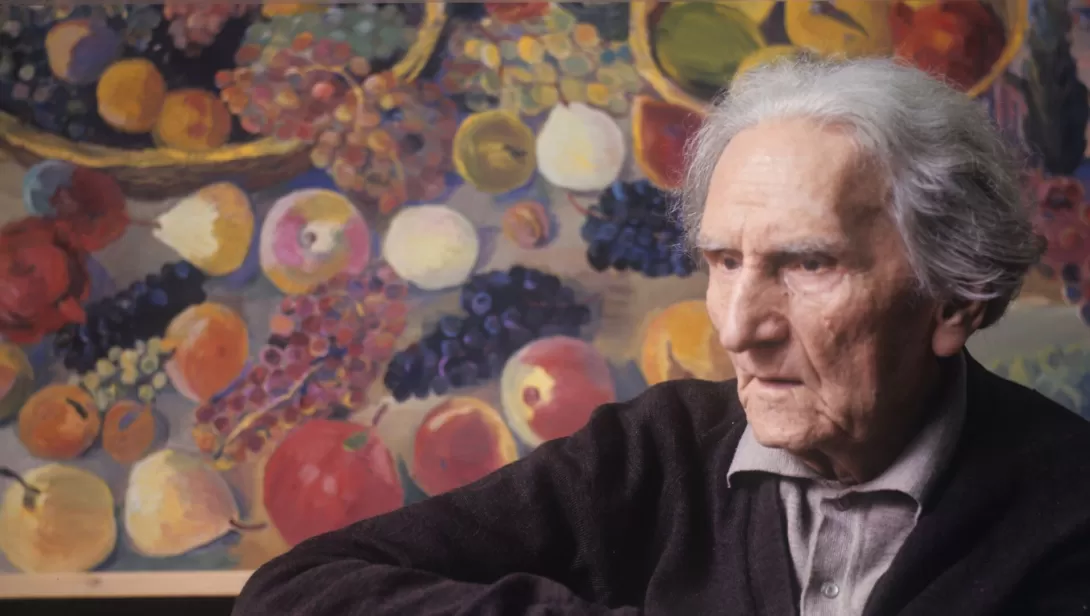
Martiros Saryan Created His Own Vision of Armenia
Martiros Saryan (1880–1972) is regarded as one of the founders of the modern Armenian national school of painting. He is best known for his landscapes of Armenia, rich colors, portraits and still lifes. Saryan grew up in an Armenian family in the Don region, trained as an artist in Moscow and first saw the country that would become the central subject of his work only as an adult.
Childhood in New Nakhichevan
Martiros was born on February 28, 1880, in New Nakhichevan, now part of Rostov-on-Don. There were nine children in the Saryan family. When Martiros was young, his father, Sarkis, quarreled with his brother and moved the family to the steppe near the Sea of Azov, where he was building a house of his own.
For a time, the Saryans slept under the open sky. His father then dug a well beside the Sambek River and built a house of unfired brick with a reed roof. The artist later recalled: “Our large family lived in it as though it were a palace.” The vastness of the steppe and its changing light and weather stayed with him from childhood.
His parents told their children about Armenia, which they considered the family's homeland. Martiros first came to know its mountains, gorges and gardens through these stories. At seven, he began attending the Armenian-Russian municipal school in New Nakhichevan. His drawing teacher there was Andrey Bakhmutsky, and the boy brought maps colored in watercolor to his geography lessons.
Studying in Moscow
In 1897, Saryan enrolled at the Moscow School of Painting, Sculpture and Architecture. He received his professional training there and, after completing the core course, studied in the studios of Konstantin Korovin and Valentin Serov. In 1903, Saryan graduated with a diploma and two silver medals.
His studies did not end there. In 1903–1904, he continued his training in the portrait studio run by Serov and Korovin. By then, his trips to Armenia had already provided subjects for independent work.
First Visits to Armenia
Saryan first visited Armenia in 1901. During his travels in 1901–1904, he visited Lori and Shirak, Etchmiadzin and Yerevan, and saw Lake Sevan. The places he had heard about from his parents were now finding their way into his paintings.
His earliest Armenian landscapes include “Makravank” and “Mount Aragats,” both from 1902. In 1903, he painted “Buffaloes. Sevan,” “Evening in the Garden” and “In an Armenian Village.” The artist explored both the scenery and the lives of the people within it.
In 1904–1905, impressions from these journeys formed the basis of the series “Fairy Tales and Dreams.” It included “At the Foot of Ararat,” “The Spell of the Sun,” “By the Water” and other works. Saryan did not seek to reproduce the landscapes he had seen exactly: in his paintings, colors became brighter, and real places merged with imagery close to Symbolism.
Exhibitions and Explorations of Color
In 1907, works from “Fairy Tales and Dreams” were shown at the “Blue Rose” exhibition in Moscow. Saryan's contributions included “Fairy Tales” and “Dreams.” During these same years, he was discovering modern French painting through the Moscow collections of Sergei Shchukin and Ivan Morozov.
In 1909, he painted “To the Spring,” “Heat. Running Dog,” “Hyenas” and “In the Grove by the Sambek.” Saryan continued to explore the expressive use of color already evident in his Armenian landscapes. In 1910–1913, travels through Turkey, Egypt and Persia added to his earlier impressions.
In the early 1910s, the Tretyakov Gallery began acquiring Saryan's work. Its collection includes his “Wisteria,” “Green Jug and Bouquet” and “Street. Noon. Constantinople.” Discussing the artist's use of color, the French poet Louis Aragon placed him alongside Matisse and Cézanne.
Moving to Armenia and Working There
In 1915, Saryan went to Etchmiadzin to help Armenians fleeing the genocide. It was then that he met Lusik Agayan, daughter of the Armenian writer Gazaros Agayan. Martiros and Lusik married in Tiflis in 1916. The artist would go on to paint her portrait many times.
After the October Revolution, Saryan helped establish Armenian museums in Rostov-on-Don. He founded the Armenian Museum of Local History and became the first director of the Armenian Regional Art Museum. In 1921, Saryan moved to Armenia with his family. He later spent some time in Paris.
In Armenia, the artist continued painting landscapes. Works from this period include “Armenia” from 1923, “Colorful Landscape” from 1924 and “Rainbow” from 1929. He continued to work in other genres, but views of the country he had first known through family stories occupied an increasingly prominent place in his art.
Wartime Portraits and Still Lifes
In 1937, twelve of Saryan's portraits of Armenian figures declared enemies of the people were destroyed. His portrait of the poet Yegishe Charents survived: museum staff hid it. For an artist who devoted much of his work to portraying his contemporaries, this meant the loss of an entire series of works.
During the Great Patriotic War, Saryan painted more portraits and fewer landscapes, partly because travel was difficult. In his “Self-Portrait” of 1942, he depicted himself at work, holding a brush and palette. A year later, he painted “Self-Portrait. Three Ages,” bringing together on one canvas images of himself in youth, in maturity and at the time he painted the picture.
His portraits from those years include the People's Teacher Simak Saakyan in a work from 1942, and the scholars Stepan Malkhasyan and Rachiya Acharyan in works from 1943. Saryan also sketched soldiers, doctors and nurses in hospitals. Alongside the portraits came still lifes: “Flowers” in 1941 and “Grapes” in 1943.
In 1945, the artist painted the still life “To the Armenian Soldiers of the Great Patriotic War.” The landscape “Ararat and Hripsime” also dates from that year. Saryan continued to turn to Armenia even when circumstances restricted his travels.
Later Works and Recognition
His works of the 1950s include “Excavations at Dvin” from 1952, “Amberd” from 1957 and “Ararat and the Charents Arch” from 1958. Saryan painted places associated with Armenia's history and culture while maintaining his focus on color. In his early works, he mainly used tempera; in his later works, oils.
In 1961, Saryan received the Lenin Prize for his series “My Homeland.” He also continued painting portraits: in 1963, he painted the American writer John Steinbeck. His later works include “Mountain Landscape” from 1969. Martiros Saryan died on May 5, 1972, in Yerevan.